Claude Code session manager tools compared
Short answer
Open-source Claude Code session managers split into tmux tools (hivemux, Claude Squad, Agent Deck), a standalone terminal UI (CCManager), a terminal app (cmux) and desktop or web apps (Nimbalyst, Vibe Kanban). Pick by what you need most - worktree automation, several agent CLIs, a GUI, or a board of sessions that waits for you.
Once you run more than two or three Claude Code sessions, you need some way to start them, keep them apart and see which one is waiting. Several open-source tools do this, and they make quite different choices. This page compares them as of October 2026, based on each project’s own README and license file. hivemux is our project, so its row is written with the same rules as the others: only what the documentation says.
The tools
- hivemux — a tmux sidebar that shows every Claude Code session (running, waiting for you, or done) and lets you jump to the one that needs you. github.com/esteban-eg-kim/hivemux
- Claude Squad — “a terminal app that manages multiple Claude Code, Codex, Gemini (and other local agents including Aider) in separate workspaces”. github.com/smtg-ai/claude-squad
- CCManager — a CLI for managing multiple AI coding assistant sessions across git worktrees and projects. github.com/kbwo/ccmanager
- Agent Deck — a terminal session manager for AI coding agents: “One TUI for Claude, Gemini, OpenCode, Codex, and more.” github.com/asheshgoplani/agent-deck
- cmux — “A Ghostty-based macOS terminal with vertical tabs and notifications for AI coding agents”. github.com/manaflow-ai/cmux
- Nimbalyst (formerly Crystal) — an open-source visual workspace for building with Codex, Claude Code, OpenCode and other agents. github.com/Nimbalyst/nimbalyst
- Vibe Kanban — a kanban board for running Claude Code, Gemini CLI, Codex, Amp and other agents. github.com/BloopAI/vibe-kanban
Comparison table (as of October 2026)
| Tool | Approach | Terminal / tmux | Git worktrees | Status and notifications | Agents | Platform | License |
|---|---|---|---|---|---|---|---|
| hivemux | Sidebar in every tmux window | tmux required; Ghostty recommended | Not managed (open any folder or worktree with hm) |
Running / needs input / done / idle from Claude Code hooks; macOS notifications; pickup board in the status line | Claude Code | macOS (Linux untested) | MIT |
| Claude Squad | TUI (cs) |
tmux required | Yes, one per session | No state detection or notifications stated | Claude Code, Codex, Gemini, Aider, any command | Not stated (release builds for macOS, Linux, Windows) | AGPL-3.0 |
| CCManager | CLI / TUI over its own PTYs | No tmux | Yes: create, merge, delete in the app | Busy / waiting / idle per agent; status-change hooks for your own notifier | Claude Code, Gemini CLI, Codex CLI, Cursor Agent, Copilot CLI, Cline, OpenCode, Kimi and more | Not stated (mentions a Windows path) | MIT |
| Agent Deck | TUI, plus a local web UI | tmux | Yes, with finish (merge + cleanup) and setup scripts | Running / waiting / idle / error; waiting sessions in the tmux status bar | Claude Code, Gemini CLI, OpenCode, Codex, Copilot, Cursor and more | macOS, Linux, Windows (WSL) | MIT |
| cmux | Native macOS terminal app | Its own terminal (libghostty); tmux optional | Not mentioned in README | Pane rings, unread badges and macOS notifications from terminal escapes or cmux notify |
Any terminal agent | macOS | GPL-3.0-or-later (app); server parts BUSL-1.1 |
| Nimbalyst | Electron desktop app, iOS companion | Embedded terminal; no tmux mentioned | Yes, one per agent | Session board; mobile push when an agent is waiting | Claude Code, Codex; others in alpha | macOS, Windows, Linux, iOS | MIT |
| Vibe Kanban | Local web UI with kanban board | No tmux mentioned | Yes, workspaces are worktrees | Not stated | Claude Code, Codex, Gemini CLI, Copilot, Amp, Cursor, OpenCode and more | Not stated (runs with npx) |
Apache-2.0 |
“Not stated” means the README does not say; it does not mean the feature is missing.
What each tool does better
Claude Squad is the long-standing tmux option for isolating each task. Every session gets its own worktree and branch, and from the TUI you can review the diff, commit and push, or check out and pause a session. It can run any agent command, and has an experimental auto-accept mode for background tasks. Install with brew install claude-squad.
CCManager does not need tmux at all, which makes it the lightest to adopt. It detects busy, waiting and idle per agent, manages worktrees from inside the app (including .worktreeinclude and post-creation hooks), restores sessions after a restart, copies Claude Code session data between worktrees, and can keep agents in a devcontainer while the manager stays on the host. It supports the widest list of agent CLIs here. Install with npm install -g ccmanager.
Agent Deck has the most complete worktree workflow of the group (create, finish with merge and cleanup, orphan cleanup, setup and teardown scripts) and the most extras: forking a session with its history, attaching MCP servers or skills per session, a cost dashboard, search across conversations, a web UI and container sandboxes.
cmux is a complete terminal rather than an add-on. It is built on libghostty, reads your Ghostty config, and puts branch, PR, ports and the latest notification text in a vertical sidebar. Its notifications work with any agent that sends standard terminal notification escapes or calls cmux notify from a hook. Install with brew tap manaflow-ai/cmux && brew install --cask cmux.
Nimbalyst is for people who prefer a visual app: a session board, red/green diff review, built-in editors for Markdown, Mermaid and Excalidraw, and an iOS app that shows which agents need you. It runs on macOS, Windows and Linux.
Vibe Kanban turns tasks into kanban issues, each run by an agent in its own workspace with a terminal and dev server, and lets you leave review comments on diffs that go back to the agent, preview the app in a built-in browser and open PRs. Note that its company announced a shutdown in April 2026; the README says the project continues as community-maintained open source.
Where hivemux fits
hivemux does not try to manage worktrees, branches or multiple agent types. It focuses on one question across many Claude Code sessions: which one needs me now?
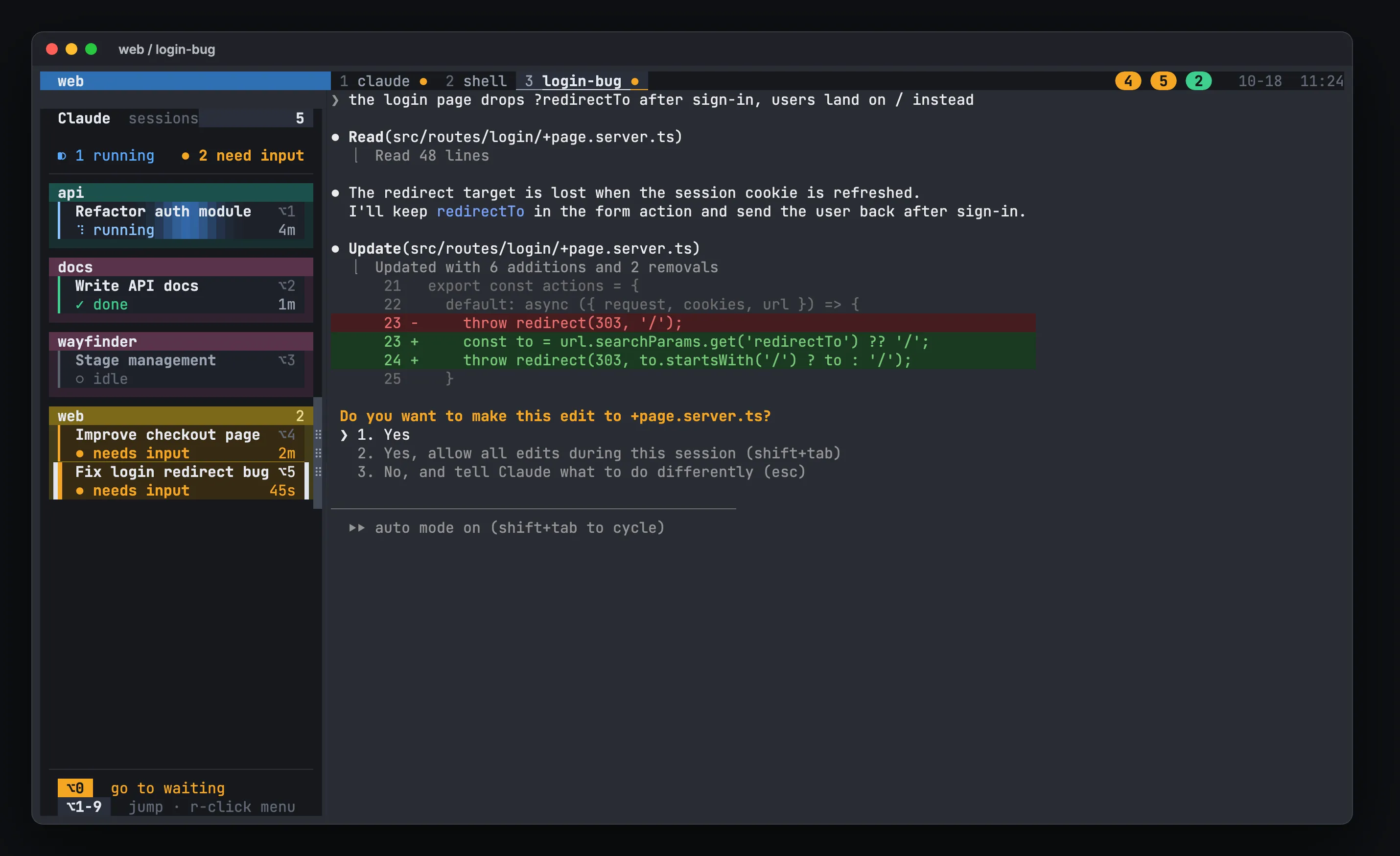
- A board of every session. A card per Claude in every tmux session, grouped by project, with state and elapsed time. It reads state written by Claude Code hooks rather than parsing screen output.
- Jumping.
Option+1…9jumps to a card;Option+0jumps to the one that has waited longest. - Notifications and a pickup board. A macOS notification when a task needs input or finishes (except the one on screen), and numbered amber and green badges in the tmux status line.
- Restore after reboot. tmux-resurrect and continuum bring back the layout, and hivemux runs
claude --resume <id>in each pane. - Another Mac and your phone.
hivemux connectattaches to another Mac’s sessions over ssh or mosh, forwarding its dev server ports; setup can turn on Claude Code’s Remote Control for every session. - The bee office. An optional window where every session is a bee that works at a desk and runs to the boss room when it needs you.
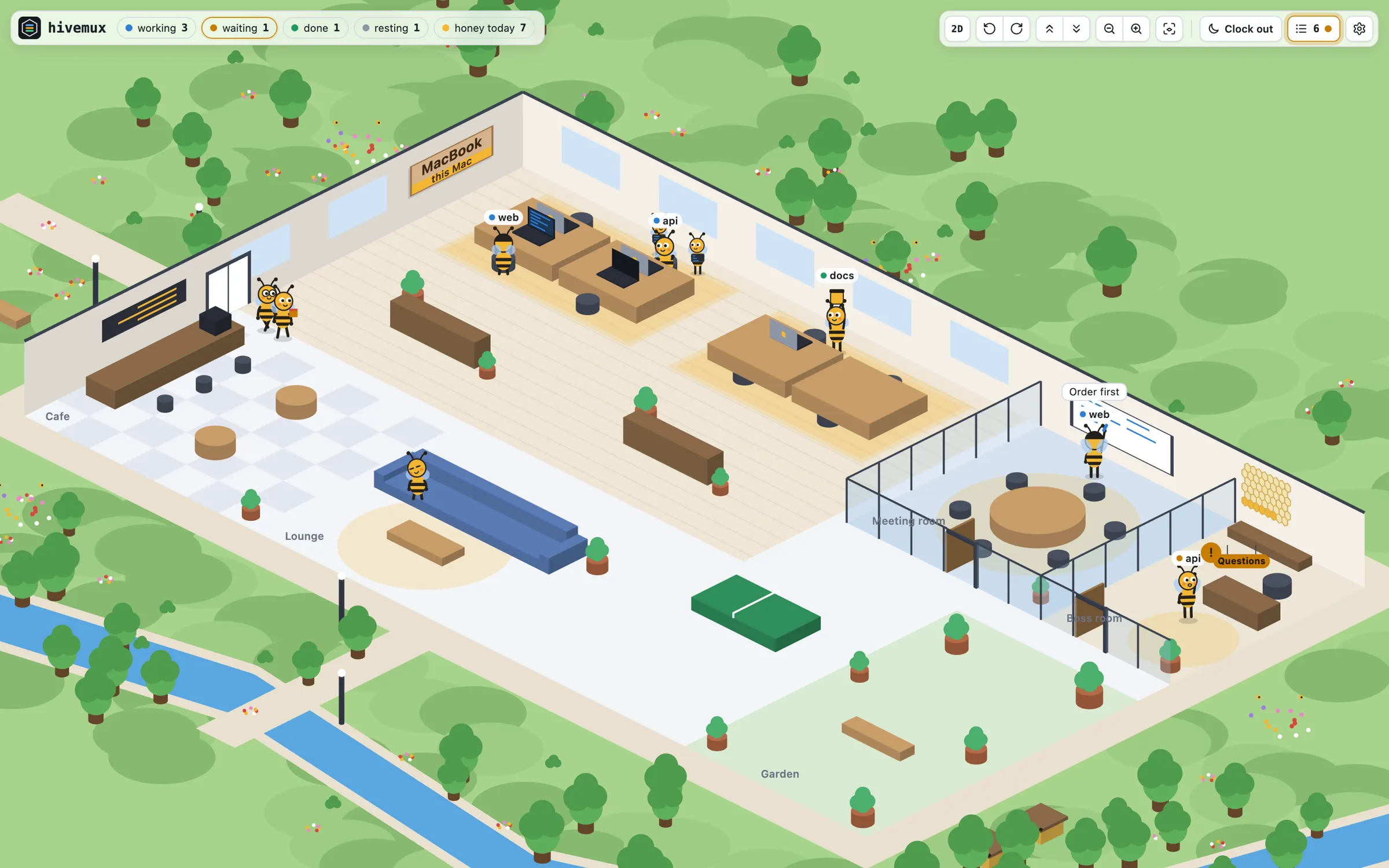
Its limits, stated plainly: Claude Code only, macOS only (Linux untested), and it requires tmux. If you want worktrees created for you, combine it with git worktree or pick a tool from the list above.
brew install esteban-eg-kim/tap/hivemuxhivemux setupNot included
Conductor (conductor.build) is a Mac app that runs Claude Code and other agents in isolated workspaces, but no public source repository was found, so it is left out of this open-source comparison. Claude Code also has its own features for parallel work, which apply whichever manager you choose; see How to run multiple Claude Code sessions at once.
Projects change quickly. Check each repository for the current state before you choose, and if a row here is out of date, open an issue on the hivemux repository.
FAQ
What is the best Claude Code session manager?
It depends on your workflow. For automatic worktrees per task, Claude Squad, CCManager or Agent Deck; for a native terminal with agent notifications, cmux; for a visual app, Nimbalyst or Vibe Kanban; for a tmux board of every Claude session with restore after reboot, hivemux.
Do I need tmux to manage several Claude Code sessions?
No. CCManager runs sessions in its own pseudo-terminals, cmux is its own terminal, and Nimbalyst and Vibe Kanban are GUI apps. Claude Squad, Agent Deck and hivemux use tmux.
Which tools support agents other than Claude Code?
Claude Squad, CCManager, Agent Deck, cmux, Nimbalyst and Vibe Kanban all support other CLIs such as Codex or Gemini CLI. hivemux supports Claude Code only.
Which of these tools create git worktrees automatically?
Claude Squad, CCManager, Agent Deck, Nimbalyst and Vibe Kanban create a worktree per session or task. hivemux and cmux do not manage worktrees according to their documentation.
Is Conductor open source?
No public source repository was found for Conductor (conductor.build), so it is not included in this open-source comparison.